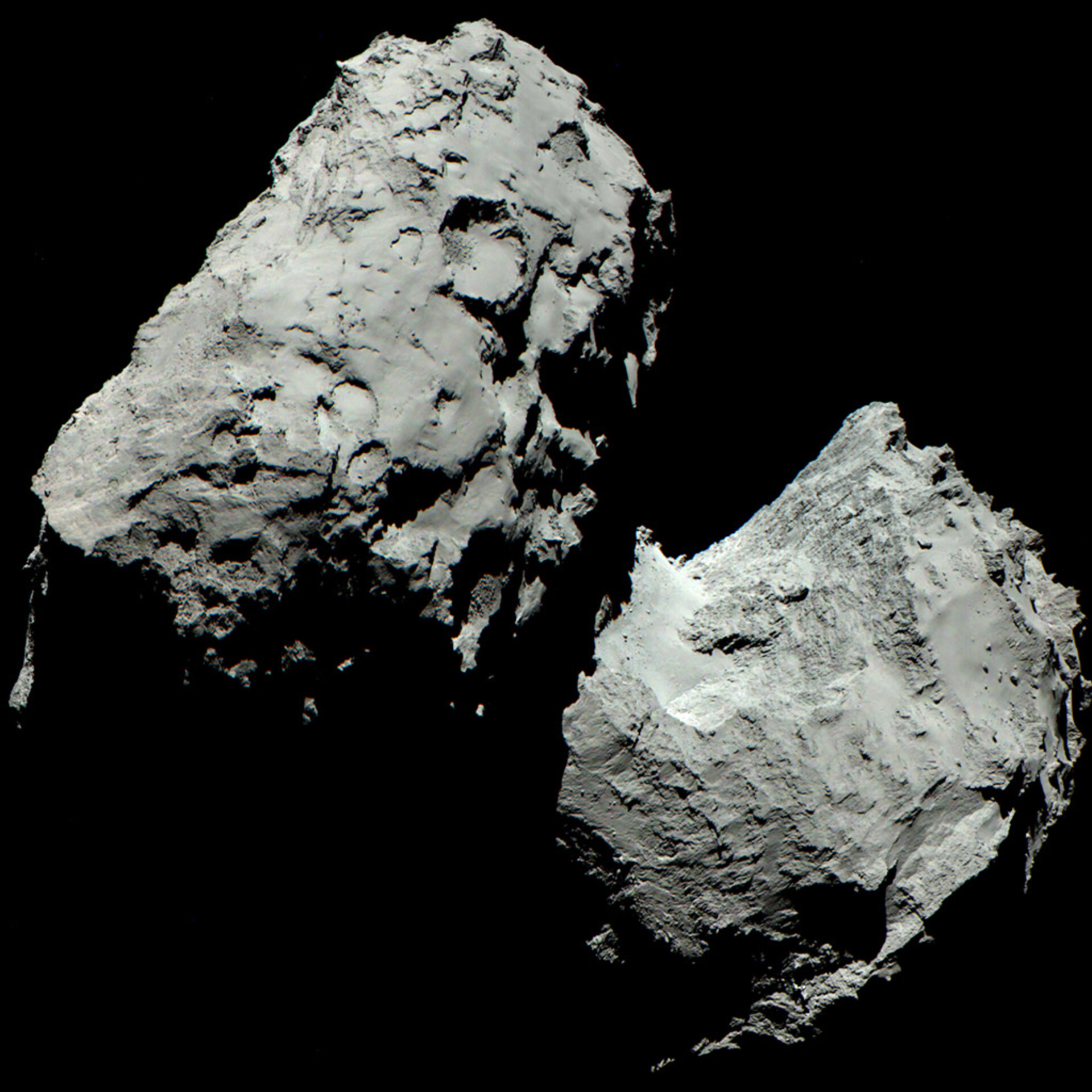
67P/Churyumov–Gerasimenko
CometWikipedia
4
MENTIONS
4
EPISODES
4
PODCASTS
Search complete. 4 mentions across 4 episodes found for "67P/Churyumov–Gerasimenko".
Oct 9, 2026

Cecilia TubianaGUEST
So the, the water production rate is pretty large.
Cecilia TubianaGUEST
Uh, larger than, uh, other, uh, comets, for instance, of the 67P which was a target of the Rosetta mission, which show a much, uh, smaller production rate.
Cecilia TubianaGUEST
But it is not, like, extraordinary large.
Cecilia TubianaGUEST
There are other comets which, uh, like the Comet Halley which has shown a production rate which is-

Alex McColganHOST
A long-standing theory is that life has propagated through the galaxy on the backs of comets, although it is quite an outside possibility.
Alex McColganHOST
The Philae lander that visited the comet 67P/Churyumov–Gerasimenko in 2004 was originally proposed to have life-detecting instrumentation on board.
Alex McColganHOST
Sadly, this idea was laughed out of court.
Alex McColganHOST
But as it turns out, the comet is rich with organic material, and there are clumps that resemble viral particles.

speaker_1HOST
But to prove that, the water on those comets must match the isotopic signature of the water in Earth's oceans.
speaker_1HOST
The ESA's Rosetta mission, which rendezvous with Comet 67P in 2014, found that 67P's water had a very different D-H ratio than Earth's water, which sort of complicated the theory.
speaker_5HOST
Oh, interesting.
speaker_1HOST
But Halley's Comet belongs to a different class, a different family of cometary bodies.

Brett McGuireHOST
on the Archive.
Brett McGuireHOST
Nitrogen appears strongly depleted in comets, and one explanation is that it hides in less volatile ammonium salts, as Rosetta results in 67P and some recent ice detections in disks seem to suggest.
Brett McGuireHOST
The authors here add acid-based salt formation on grain surfaces to a thermochemical disk model that couples vertical hydrostatic structure, gas heating and cooling, and temperature-dependent gas-grain chemistry.
Brett McGuireHOST
They see that salts accumulate only in the inner midplane, within roughly 50 AU, where grains are warm enough for acidic partners such as HCN, HNCO, and H2S to diffuse toward relatively immobile ammonia.