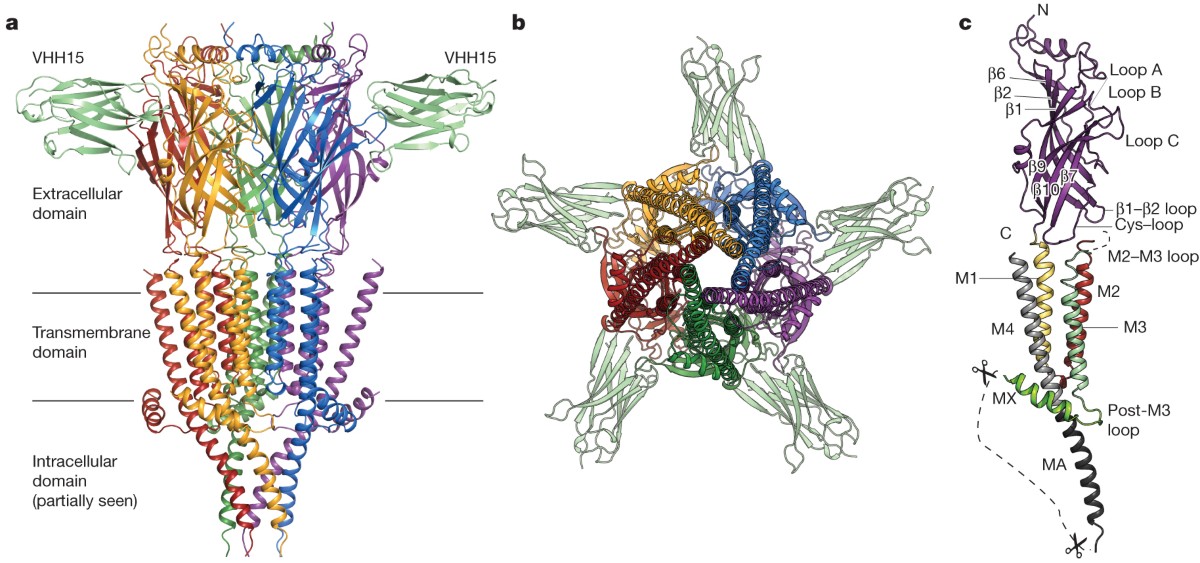
5-HT3 receptor
ProteinWikipedia
7
MENTIONS
4
EPISODES
3
PODCASTS
Search complete. 7 mentions across 4 episodes found for "5-HT3 receptor".
Oct 20, 2026

CarlosHOST
Many second-generation antipsychotics, including risperidone and olanzapine, antagonize this receptor alongside dopamine receptors.
CarlosHOST
Including our 5-HT3 receptor contributes to nausea and vomiting.
CarlosHOST
So here you're looking at adenositrone, an antiemetic, which blocks this receptor.
CarlosHOST
So 5-HT1A participates in anxiety and mood regulation.
CarlosHOST
5-H2A is associated with perception and cortical signaling.
CarlosHOST
This is the P pain perception component.
CarlosHOST
And 5-HT3 contributes to nausea.
CarlosHOST
That's gastrointestinal functioning and vomiting.

speaker_3HOST
Many second-generation antipsychotics, including risperidone and olanzapine, antagonize this receptor alongside dopamine receptors.
speaker_3HOST
Including our 5-HT3 receptor contributes to nausea and vomiting.
speaker_3HOST
So here you're looking at adenositrone, an antiemetic, which blocks this receptor.
speaker_3HOST
So 5-HT1A participates in anxiety and mood regulation.
speaker_3HOST
5-H2A is associated with perception and cortical signaling.
speaker_3HOST
This is the P pain perception component.
speaker_3HOST
And 5-HT3 contributes to nausea.
speaker_3HOST
That's gastrointestinal functioning and vomiting.

Daniel SouterHOST
Mirtazapine blocks alpha-2 receptors in the brain, which leads to downstream increases in norepinephrine and serotonin release.
Daniel SouterHOST
It also does block several serotonin receptors, particularly 5-HT2 and 5-HT3, and it strongly blocks histamine H1 receptors.
Daniel SouterHOST
That antihistamine effect is what explains the sleep and appetite-inducing properties.
Daniel SouterHOST
So it again has a very different profile from an SS or SNRI, which is part of the rationale for combining them.
CarlosHOST
Many second-generation antipsychotics, including risperidone and olanzapine, antagonize this receptor alongside dopamine receptors.
CarlosHOST
Including our 5-HT3 receptor contributes to nausea and vomiting.
CarlosHOST
So here you're looking at adenositrone, an antiemetic, which blocks this receptor.
CarlosHOST
So 5-HT1A participates in anxiety and mood regulation.
CarlosHOST
5-H2A is associated with perception and cortical signaling.
CarlosHOST
This is the P pain perception component.
CarlosHOST
And 5-HT3 contributes to nausea, that's gastrointestinal functioning, and vomiting.
CarlosHOST
These three receptor associations because they connect neurobiology with clinical prescribing, that's why it's important to remember.