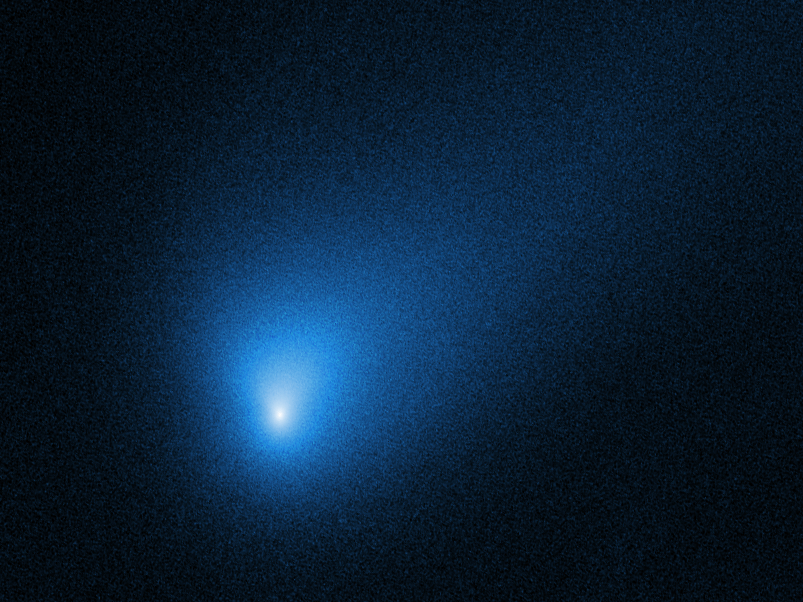
2I/Borisov
CometWikipedia
7
MENTIONS
5
EPISODES
5
PODCASTS
Search complete. 7 mentions across 5 episodes found for "2I/Borisov".
Oct 9, 2026

Franck MarchisHOST
We even saw it when it was leaving.
Franck MarchisHOST
Then we have Borisov.
Franck MarchisHOST
Uh, this one we are a bit more ready, I will say.
Franck MarchisHOST
Then we have this one, 3I Atlas.

Sarah Al-AhmedHOST
We- we've only had three of these that we've found so far.
Sarah Al-AhmedHOST
There was one, ‘Oumuamua, two, Borisov, and then most recently, three, Atlas.
James BickfordGUEST
Mm-hmm.
Sarah Al-AhmedHOST
We haven't seen a lot of them, but with the new Vera Rubin telescope and the survey it's gonna be taking, we might be seeing a lot more of these.

Steve NerlichHOST
That is, it was moving so fast that it was clearly going to achieve escape velocity from the Sun, and tracking its trajectory back, we're confident it must have come from outside the solar system initially.
Steve NerlichHOST
Since ʻOumuamua, we've also identified an interstellar comet called Borisov, which was also observed just passing through in twenty nineteen.
Steve NerlichHOST
We've also had an alleged interstellar meteor known as the Manus Island fireball, which crashed to Earth in twenty fourteen.
Steve NerlichHOST
Subsequent analysis suggesting a high likelihood that it had also been moving too fast to have been in a bound orbit around the Sun.

Stuart GaryHOST
3I/ATLAS is the third interstellar object ever discovered.
Stuart GaryHOST
It follows 1I/Oumuamua back in 2017 and 2I/Borisov in 2019.
Stuart GaryHOST
It was found as it was approaching the sun, spending enough time in our solar system for astronomers to study it in some detail.
Stuart GaryHOST
While it was difficult to measure the composition of the first two interstellar objects, with no gas detected from Oumuamua and Borisov being too faint, this was not the case for 3I/ATLAS.
Stuart GaryHOST
Thanks to the object's unprecedented brightness, the authors were able to measure the comet's isotopic ratios, the relative amounts of different forms of the same element.
Stuart GaryHOST
They measured the ratios of carbon and nitrogen isotopes in cyanide molecules present in the gas around the comet.
Davide FarnocchiaSOUNDBITE_SPEAKER
We're really excited about this object.
Davide FarnocchiaSOUNDBITE_SPEAKER
So far, we've discovered three interstellar objects.

Chris LintottGUEST
So that's why we're finding it hard to spot them, 'cause they're small, and they're fast-moving.
Chris LintottGUEST
We found one called 'Oumuamua in 2017, and then Borisov in 2019, and then just last year we had one called Atlas that came shooting through the solar system.
David O'DohertyHOST
Who's doing the 8:30?
Chris LintottGUEST
Well, I have to find it first b- because I don't know that.