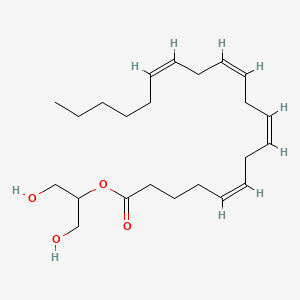
2-Arachidonoylglycerol
Chemical compoundWikipedia
44
MENTIONS
12
EPISODES
12
PODCASTS
Search complete. 44 mentions across 12 episodes found for "2-Arachidonoylglycerol".
Sep 13, 2026

Ian BrighthopeGUEST
There's a feedback mechanism, and that's the endocannabinoid.
Ian BrighthopeGUEST
And the two major endocannabinoids, one is called anandamine and the other is 2-AG.
Ian BrighthopeGUEST
And the anandamine comes from the word ananda, which means pleasure and peace.
Ian BrighthopeGUEST
So I think what it does, it actually... modulates not just the nervous system, but the immune system as well.

Manaan KarrayHOST
rapidly changing legal and cultural status of cannabis globally, patients are constantly asking their doctors about using it for anxiety.
Manaan KarrayHOST
The textbook breaks down the endogenous ligands like anandamide and 2-AG and the primary receptors CB1 and CB2.
Manaan KarrayHOST
What is the fundamental neurobiological mechanism of this system?
speaker_1HOST
The endocannabinoid system is unique.

Kaya GencGUEST
So you go, wow, okay.
Kaya GencGUEST
So based off endocannabinoid receptors, CB1, CB2, CB2, The individual cannabinoids that are made in the body, like 2-AG and anandamide, you go, okay, so we have adaptation to this, and the body seems to tolerate these chemicals well because there's some adaptation to it.
Kaya GencGUEST
And when you realize what it does on a mechanistic level, and this is based off PET data in particular… Cannabis actually seems to have neuromodulatory properties.
Kaya GencGUEST
So you go, this works like a homeostasis agent.

Onder AlbayramGUEST
Then they discovered endocannabinoids, which I mean is the body produce its own cannabis.
Onder AlbayramGUEST
It's on THC, what we call them endocannabinoids, anandamide and 2-AG.
Onder AlbayramGUEST
And those are the endogenous ligand of this receptor.
Onder AlbayramGUEST
And then this is a very complex system.
Stefan DillingerHOST
So is there a difference in the expression level of these receptors and the age? That is right.
Onder AlbayramGUEST
Exactly.
Onder AlbayramGUEST
After that, what I discovered that was the most important thing in, I think, the base of my story is What I discovered that, which is evolutionary concern, we don't know why, in particularly the hippocampus of the brain and 2-AG, which is main endogenous ligands of the cannabinoid 1 receptor, and it is biosynthesis enzyme, which we call DAGEL-alpha, significantly reduced during aging.
Onder AlbayramGUEST
Significantly.

Justin KanderGUEST
The evidence is overwhelming.
Justin KanderGUEST
We didn't really get into it, but endocannabinoids, anandamide, and 2-AG also kill cancer cells.
Justin KanderGUEST
So Phytocannabinoids and endocannabinoids kill cancer cells.
Justin KanderGUEST
That's why cannabis is working so well in humans.

JulieHOST
The study can't tell us that, but it can make us ask a much better question than, "Why do kinky people like being hurt?" Then I found another study by the same research group, this one called Between Pleasure and Pain, and here, things get even stranger.
JulieHOST
They took blood samples from dominants and submissives before and after actual BDSM play and measured cortisol, which is involved in our stress response, as well as endocannabinoids, including anandamide and something called 2-AG.
JulieHOST
Yes, I'm not pretending I know everything [laughs] and I also had no idea what the fuck an endocannabinoid was before I started researching this episode.
JulieHOST
So basically, they are chemicals that our bodies naturally produce, and they're involved in things like pain, stress, mood, and reward.
JulieHOST
Dominants involved in power play showed higher levels of the two endocannabinoids the researchers were studying.
JulieHOST
For submissives, the pattern was different.
JulieHOST
Pain play was associated with higher 2-AG.
JulieHOST
Now, please don't leave this episode and tell somebody, "Oh, you know, science has proven dominants don't care about the pain.

Uwe BleschingGUEST
There are two known endocannabinoids.
Uwe BleschingGUEST
One is called anandamide, and the other one is called 2-AG.
Uwe BleschingGUEST
And both of those re- both of those endocannabinoids tend to be, uh, lower in patients with chronic diseases.
Uwe BleschingGUEST
And so one, and again, one other reason why cannabis can be utilized to compensate for the lack of natural occurring endocannabinoids, which is part and parcel of the problem of most chronic diseases.
47 MINS LATER
Uwe BleschingGUEST
Kanna like, uh, cannabis, and keys, uh, .com.
Uwe BleschingGUEST
And so, um, there you'll find a lot of free information, while primarily it's directed at paid, at patients and clinicians on a subscription base.
Uwe BleschingGUEST
But there's a lot of free information, a lot of introductory blog articles about the endocannabinoid system, about the, uh, uh, CB1 and CB2 receptor sites, about the e- endocannabinoids like anandamide or 2-AG.
Uwe BleschingGUEST
We mentioned the ones that are associated with the runner's high.

Vanessa SperandioGUEST
It looks just like Kindle, right? It's just a little modification.
Vanessa SperandioGUEST
And we also ended up finding a receptor for 2-AG, which is one of the endocannabinoids.
Janakiram SeshuHOST
So bacteria, I'm asking you kind of like an undergraduate question.
Janakiram SeshuHOST
We just thought what I'm supposed to be doing here.

Nephi StellaGUEST
very appropriate name.
Nephi StellaGUEST
And then there's a second one that I was involved in discovering, which is 2-AG.
Nephi StellaGUEST
And even, I think the field now has really recognized that these two signaling endocannabinoids, anandamide on one side and 2-AG on the other side, are actually doing very different things in the brain and have very different functions, even though they're both endocannabinoids and they act on cannabinoids we're going to be focusing on the cannabinoid CB1 receptors in the brain.
Nick JikomesHOST
Got it.
Nick JikomesHOST
So there's a bunch of different stuff in the brain and body, different types of signaling molecules, different classes, different structures, different functions.
Nephi StellaGUEST
So they are lipids.
Nephi StellaGUEST
And then we have enzymes that are going to cut those lipids, hydrolyze those lipids that are complex, and release smaller lipids that are going to be the endocannabinoids.
Nephi StellaGUEST
Those enzymes are going to be different if we're talking about the first endocannabinoid anandamide versus the second cannabinoid 2-AG.

Bhanu KollaGUEST
So that's one of them.
Bhanu KollaGUEST
And 2-AG is the other system.
Bhanu KollaGUEST
We think it plays a role in various homeostasis.
Bhanu KollaGUEST
So it seems to control appetite, sleep, but also cognition and immunity.
2 more episodes mention 2-Arachidonoylglycerol.
Create an account to see the whole feed, search across every transcript, and follow the entities you care about.