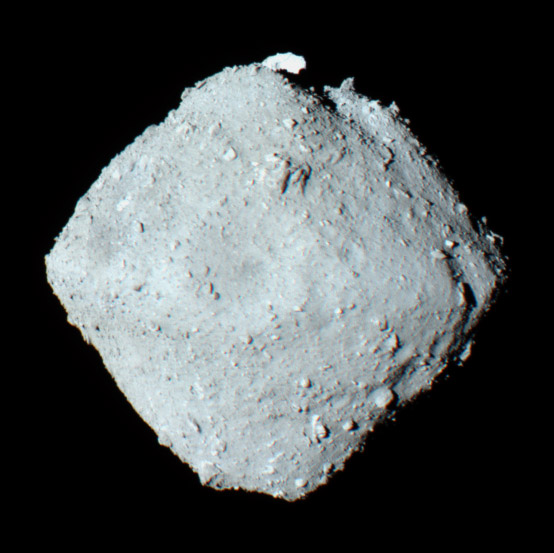
162173 Ryugu
AsteroidWikipedia
15
MENTIONS
8
EPISODES
8
PODCASTS
Search complete. 15 mentions across 8 episodes found for "162173 Ryugu".
Sep 13, 2026

Alya Al NuaimiHOST
They brought back pieces of an asteroid called Itokawa in 2010.
Alya Al NuaimiHOST
Then they did it again with another asteroid called Ryugu in 2020.
Alya Al NuaimiHOST
Both times success, both times history made.
Alya Al NuaimiHOST
So when Japan says they're going to pick up a piece... of a moon on mars or mars's moon and bring it home i believe them they burned that confidence so yeah mark your calendars october 19th a spacecraft named double mx carrying a tiny rover is going to retrieve a 10 grams sample from mars's news right that was really interesting one more story of course to go and this one is for everyone who has ever looked up at the night sky and wish they could see more because what's coming in 2028 might just be the most spectacular thing you've ever seen with your own eyes we're talking shooting stars and lots of them and it's all because of a planet you know very well stay with me this is keller mastro coming back right after this keep it right here with me on pulse 95.

James TenganHOST
But if those reactors are not restarted, some government officials are concerned the long-term energy goal may not be feasible.
James TenganHOST
Researchers at Japan's Hokkaido University and other institutes say the Ryugu asteroid explored by a Japanese probe appears to be a remnant of an early celestial body in the solar system from more than 4.5 billion years ago.
James TenganHOST
The group analyzed mineral samples from Ryugu collected by the probe Hayabusa2.
James TenganHOST
The researchers say their analysis indicates the parent body of the asteroid was formed earlier than 4.5653 billion years ago.
James TenganHOST
They say this dates back to the period less than two million years after the beginning of the formation of the solar system.
James TenganHOST
Previous studies found that Ryugu emerged from a collection of fragments after its parent body broke apart, but it was not clear when the body was created.
James TenganHOST
The group says the latest findings could provide a clue to the formation of celestial bodies in the solar system.
speaker_1SOUNDBITE_SPEAKER
We would also like to examine the time of formation of another asteroid, samples of which were brought back by the US space agency, NASA.

SageHOST
Give me that chaotic energy, I guess.
SageHOST
According to some scientists, a space object containing water happened to collide with Earth like a cosmic water balloon, and voila! Blue planet was born! We know that might be possible because the Ryugu and Bennu asteroids orbiting in our solar system have shown evidence of the same type of water that exists in Earth's oceans.
SageHOST
So it's possible that asteroids are responsible for bringing water to the planet.
SageHOST
Or there may have been water on Earth before any asteroid strikes.

DavidHOST
The sample return missions represent a golden age for planetary archaeology.
DavidHOST
The Japanese Hayabusa 2 mission successfully retrieved and returned samples from the asteroid Ryugu.
speaker_1HOST
And NASA's OSIRIS-REx mission recently delivered a massive, pristine sample from the asteroid Bennu.
DavidHOST
Both Ryugu and Bennu are carbonaceous CC rocks.
DavidHOST
They represent the cold, dark outer solar system.
DavidHOST
When we finally got these pristine samples into terrestrial laboratories, what did the mass spectrometers reveal?

Carl FranklinHOST
Mm-hmm.
Richard CampbellHOST
Uh, in October, OSIRIS-REx, one of the asteroid missions, uh, touches on, uh, asteroid Bennu and collects a sample there.
Richard CampbellHOST
In fact, it does a little too well because when it touches, uh, Bennu is very much a rubble pile, and all that gravel goes everywhere.
Carl FranklinHOST
Hmm.
Richard CampbellHOST
They have to come up with such technical ma- maneuvers as shaking a little off [laughs] to try and get the thing closed up so they can put it in the capsule to return.
Carl FranklinHOST
Hmm.
Richard CampbellHOST
Uh, another asteroid mission at the end of the year in December, Hayabusa2, will actually successfully return its sample payload from the asteroid Ryugu, and that is a JAXA mission.
Richard CampbellHOST
A little recap on what SpaceX did in 2020.

speaker_3HOST
Absolutely.
speaker_3HOST
In 2020, the unmanned Hayabusa2 spacecraft successfully returned to Earth with samples it had collected from an asteroid named Ryugu, located hundreds of millions of kilometers away.
speaker_2HOST
It brought back exactly 5.4 grams of rock and dust.
speaker_2HOST
At the time, that was a massive scientific triumph.

Richard CampbellHOST
Uh, there's a couple of asteroid missions.
Richard CampbellHOST
Hayabusa2 in June got to Ryugu.
Richard CampbellHOST
And, uh, in Oc- uh, in, um, December Uh, OSIRIS-REx gets to Bennu, which is cool.
Richard CampbellHOST
They, we start to explore asteroids sort of on a regular basis.

Samantha YammineHOST
That mission confirmed that the ingredients for DNA and RNA exist out there, at least on Bennu.
Samantha YammineHOST
Ryugu is a carbon-rich asteroid that loops around the sun somewhere between Earth and Mars.
Samantha YammineHOST
Its parent body may have formed way out in the far reaches of our solar system before drifting inwards.
Samantha YammineHOST
So it's kind of like a chemical time capsule from the birth of our solar system some 4.6 billion years ago.
Samantha YammineHOST
An earlier sampling of Ryugu had turned up a tiny sample of the RNA building block uracil.
Samantha YammineHOST
So this time, Japan's space agency wanted to get an even bigger sample.
Samantha YammineHOST
The Hayabusa2 spacecraft scooped up Ryugu's dust in space in 2019.
Samantha YammineHOST
It sealed the dust in an airtight capsule that landed back on Earth without ever touching Earth's air or biology.