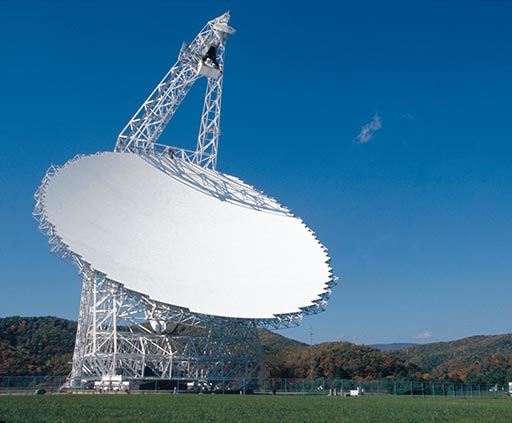
National Radio Astronomy Observatory
BankWikipedia
13
MENTIONS
9
EPISODES
8
PODCASTS
Search complete. 13 mentions across 9 episodes found for "National Radio Astronomy Observatory".
Oct 2, 2026

H. Paul ShuchGUEST
No, unfortunately not.
H. Paul ShuchGUEST
They were using the Arecibo dish, and they were borrowing time on a really nice big telescope in Australia, and they would rent time from the NIO, Green Bank, West Virginia.
H. Paul ShuchGUEST
Big stuff.
H. Paul ShuchGUEST
Well, because it's a long shot with your targeted search, the second search strategy is called the All-Sky Survey.
H. Paul ShuchGUEST
So NASA wasn't about to bet on one or the other.
H. Paul ShuchGUEST
They bet on both.
H. Paul ShuchGUEST
JPL got involved with one of the searches, and National Radio Astronomy Observatory got involved in the other search, and they had these both going on a three-year plan at $12 million a year.
H. Paul ShuchGUEST
That's, by the way, five cents per U.S. citizen per year.

Brennan ByrneHOST
Frank Drake studied astronomy, getting his PhD from Harvard in 1958.
Brennan ByrneHOST
His first job was at the National Radio Astronomy Observatory in Green Bank, West Virginia.
Brennan ByrneHOST
And it was there in 1960 where he would get that chance to detect those other civilizations in our universe that young Frank wondered about.
Brennan ByrneHOST
That year, he convinced the observatory director to give him $2,000 to conduct the first search for life outside our own planet.

Samantha ScibelliHOST
I'm Samantha Schibelli.
Samantha ScibelliHOST
I'm a postdoctoral fellow at the National Radio Astronomy Observatory in Charlottesville, Virginia.
Samantha ScibelliHOST
I'm interviewing Funga Hill, who was an undergraduate at the University of Arizona and now is starting graduate school at the University of Michigan.
Samantha ScibelliHOST
I want to start by asking first, Funga, how did you get interested in astrochemistry?

James Sobel KellyNARRATOR
The first serious effort to detect radio signals from alien civilizations in deep space was made in 1960, when the American astronomer Frank Drake conducted an experiment he named Project OSMA.
James Sobel KellyNARRATOR
Using a telescope at the National Radio Astronomy Observatory in West Virginia, Drake looked for signals at a precise location on the electromagnetic spectrum.
James Sobel KellyNARRATOR
1420 megahertz, known as the hydrogen line, because hydrogen atoms emit photons at that frequency.
James Sobel KellyNARRATOR
Because hydrogen is so abundant in the universe, the line is easy for radio telescopes to detect.

Stuart GaryHOST
In the meantime, another possibility is to point powerful telescopes at Enceladus and use those to try and get a spectroscopic reading of those tiny water and ice grains erupting into space from the tiger stripes.
Stuart GaryHOST
This report from the United States National Radio Astronomy Observatory.
Bryan ButlerSOUNDBITE_SPEAKER
Enceladus has geysers at its south pole.
Bryan ButlerSOUNDBITE_SPEAKER
It has what almost are the equivalent of geothermal geysers on the Earth.
Bryan ButlerSOUNDBITE_SPEAKER
So on Enceladus, is there some ocean where material is coming up through the crust and that's what's coming out in these geysers? So we'll be able to quite accurately measure the abundances of the different kinds of molecules that are in that, you know, that ring of material around Saturn.
Bryan ButlerSOUNDBITE_SPEAKER
And because it has such fine resolution, we'll actually be able to make an image of Enceladus and right over where the geysers are, we'll have, you know, the resolution to see precisely what's in that area, what's coming out, what the temperatures are, again, what the, the abundances are of the materials that are coming out.
Stuart GaryHOST
And in that report from the National Radio Astronomy Observatory, we heard from scientist Brian Butler.
Stuart GaryHOST
This is Space Time.

Stuart GaryHOST
In the meantime, another possibility is to point powerful telescopes at Enceladus and use those to try and get a spectroscopic reading of those tiny water and ice grains erupting into space from the tiger stripes.
Stuart GaryHOST
This report from the United States National Radio Astronomy Observatory.
Brian ButlerSOUNDBITE_SPEAKER
Enceladus has geysers at its south pole.
Brian ButlerSOUNDBITE_SPEAKER
It has what almost are the equivalent of geothermal geysers on the Earth.
Brian ButlerSOUNDBITE_SPEAKER
quite accurately measure the abundances of the different kinds of molecules that are in that, you know, that ring of material around Saturn.
Brian ButlerSOUNDBITE_SPEAKER
And because it has such fine resolution, we'll actually be able to make an image of Enceladus, and right over where the geysers are, we'll have, you know, the resolution to see precisely what's in that area, what's coming out, what the temperatures are again, what the abundances are of the materials that are coming out.
Stuart GaryHOST
And in that report from the National Radio Astronomy Observatory, we heard from scientist Brian Butler.
Stuart GaryHOST
This is Space Time.

speaker_0NARRATOR
The telescope does not hear with ears, it hears with mathematics.
speaker_0NARRATOR
In the spring of 1960, a young astronomer named Frank Drake pointed an 85-foot radio telescope at the National Radio Astronomy Observatory in Greenbank, West Virginia, at two nearby sun-like stars.
speaker_0NARRATOR
Their names were Tau Ceti and Epsilon Eridani, and they were chosen because they were close, because they were similar to our own Sun, and because they seemed like reasonable places to begin.
speaker_0NARRATOR
Drake listened for narrow band radio signals at the hydrogen line frequency, 1420 MHz.