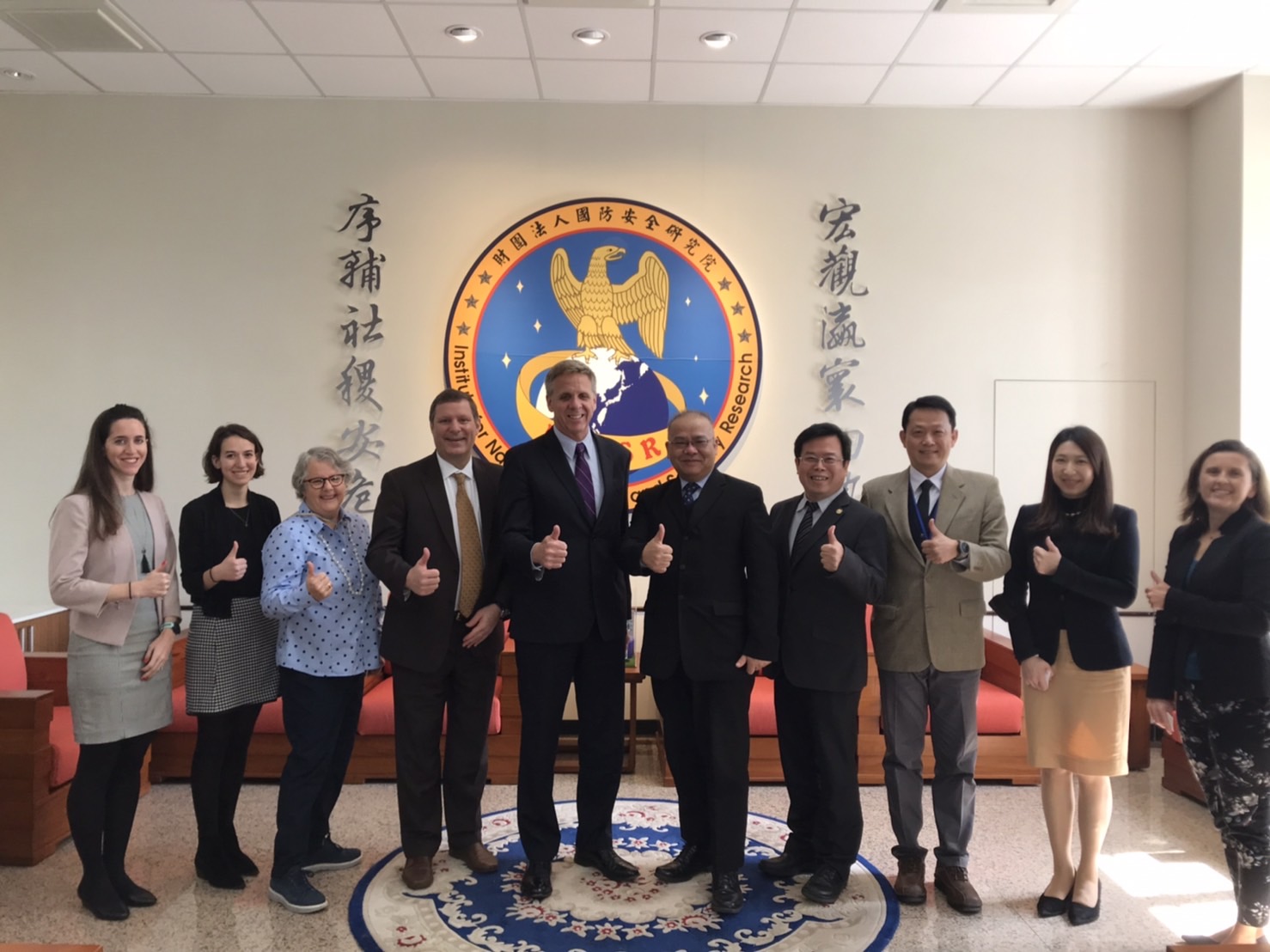
Institute for National Defense and Security Research
Government office in Taipei, TaiwanWikipedia
7
MENTIONS
6
EPISODES
2
PODCASTS
Search complete. 7 mentions across 6 episodes found for "Institute for National Defense and Security Research".
Oct 9, 2026
speaker_0NARRATOR
It's expected.
speaker_0NARRATOR
Yet data theft is only the beginning, according to Soot Sooyoon, director of the Division of Strategy and Resources at the Institute for National Defense and Security Research in Taiwan.
speaker_0NARRATOR
Once a breach is successful, the attacker can alter data undetected, causing significant misinformation, he told the Epoch Times.
speaker_0NARRATOR
The resulting damage can far exceed that of mere data theft.

David PerryHOST
In this episode of Defense Deconstructed, which we're recording September 22nd, 2026, we're talking to Claire McKendry.
David PerryHOST
She's a PhD candidate in the Department of Political Science at the University of Waterloo, a research fellow at the Conference of Defense Associations Institute, and recipient of the 2026 Global Taiwan Institute Scholarship, and a former visiting research fellow at the Institute for National Defense and Security Research in Taipei.
David PerryHOST
Her dissertation focuses on the evolution of Taiwan's policy in the South China Sea disputes And for the conversation today, she's drawing from some of that work to talk about security cooperation between Canada and North Pacific security partners, Japan and the Republic of Korea.
David PerryHOST
Enjoy.

speaker_0NARRATOR
China may also be involved in scientific research focused on the mineral exploitation of the seabed in an area that belongs to the United States, he added.
speaker_0NARRATOR
The Chinese regime's vessels are researching for future military deployments in the waters near Alaska and the Arctic, specifically the positioning of strategic nuclear submarines, Su Tsuyun, researcher and director of Division of Defense Strategy and Resources at Taiwan's Institute for National Defense and Security Research, told the Epoch Times.
speaker_0NARRATOR
Submarine-launched ballistic missiles fired from that region could reach the US mainland in as little as 15 minutes.
speaker_0NARRATOR
This is part of the geopolitical strategy pursued by the authorities in Beijing, Su said.
speaker_0NARRATOR
For the United States, China's presence in the Arctic, which directly connects Alaska, the Bering Sea, and Greenland, is viewed as a matter of U.S. homeland security, Cheng Chi-tung, associate research fellow at Taiwan's Institute for National Defense and Security Research, told the Epoch Times.
speaker_0NARRATOR
The United States has always positioned China as a non-Arctic country, but China calls itself a near-Arctic state and is actively involved in Arctic affairs.
speaker_0NARRATOR
Greenland is related to Arctic affairs and to the US homeland security, Cheng said.
speaker_0NARRATOR
Shortly after Beijing announced Zhang's fall in late January, the military's official newspaper published a sharply worded editorial accusing him and Liu of having trampled on a system that ensures Xi's authority over the PLA.
speaker_0NARRATOR
That accusation was notably absent from Monday's statement, noted Shen Mingxi, a Chinese military expert at the Institute for National Defense and Security Research, a Taiwanese defense ministry-funded think tank.
speaker_0NARRATOR
Instead, Beijing accused Zheng and Liu of taking bribes in return for giving promotions and forming cliques and factions.
speaker_0NARRATOR
The wording indicated that the purges could extend to people around the two generals, likely ensnaring their allies, subordinates, and the military officers they promoted.
speaker_0NARRATOR
India prioritizes strategic autonomy.
speaker_0NARRATOR
Shen Ming-shi, director of the Division of National Security Research at Taiwan's Institute for National Defense and Security Research, said Modi's participation in the SCO summit should not be seen as a sign of deepening China-India ties.
speaker_0NARRATOR
Since the end of the Cold War, India's core foreign policy doctrine has shifted from non-alignment to strategic autonomy, he told The Epoch Times.
speaker_0NARRATOR
This approach enables New Delhi to maneuver among major powers and international groupings, maximizing national interests while maintaining flexibility.
speaker_0NARRATOR
If the party were to collapse suddenly, that could lead to a very chaotic situation.
speaker_0NARRATOR
That's why I believe the United States should have a roadmap for such a scenario." Nuclear Warheads The biggest risks in the sudden dissolution of the CCP's central authorities would be the loss of control over weapons of mass destruction, said Shen Mingxi, a Chinese military expert at the Institute for National Defense and Security Research, a Taiwan-based think tank.
speaker_0NARRATOR
The People's Liberation Army has more than 600 nuclear warheads as of mid-2024.
speaker_0NARRATOR
a number expected to rise to 1,000 by 2030, according to the latest Pentagon assessment.