Cortical Labs
CompanyWikipedia
40
MENTIONS
16
EPISODES
15
PODCASTS
Search complete. 40 mentions across 16 episodes found for "Cortical Labs".
Sep 22, 2026

Jeremy SochaHOST
and it runs on 16 million living human neurons.
Jeremy SochaHOST
NUS Medicine, data center operator day one, and biocomputing startup, Cortical Labs, unveiled the system this month at the National University of Singapore.
Jeremy SochaHOST
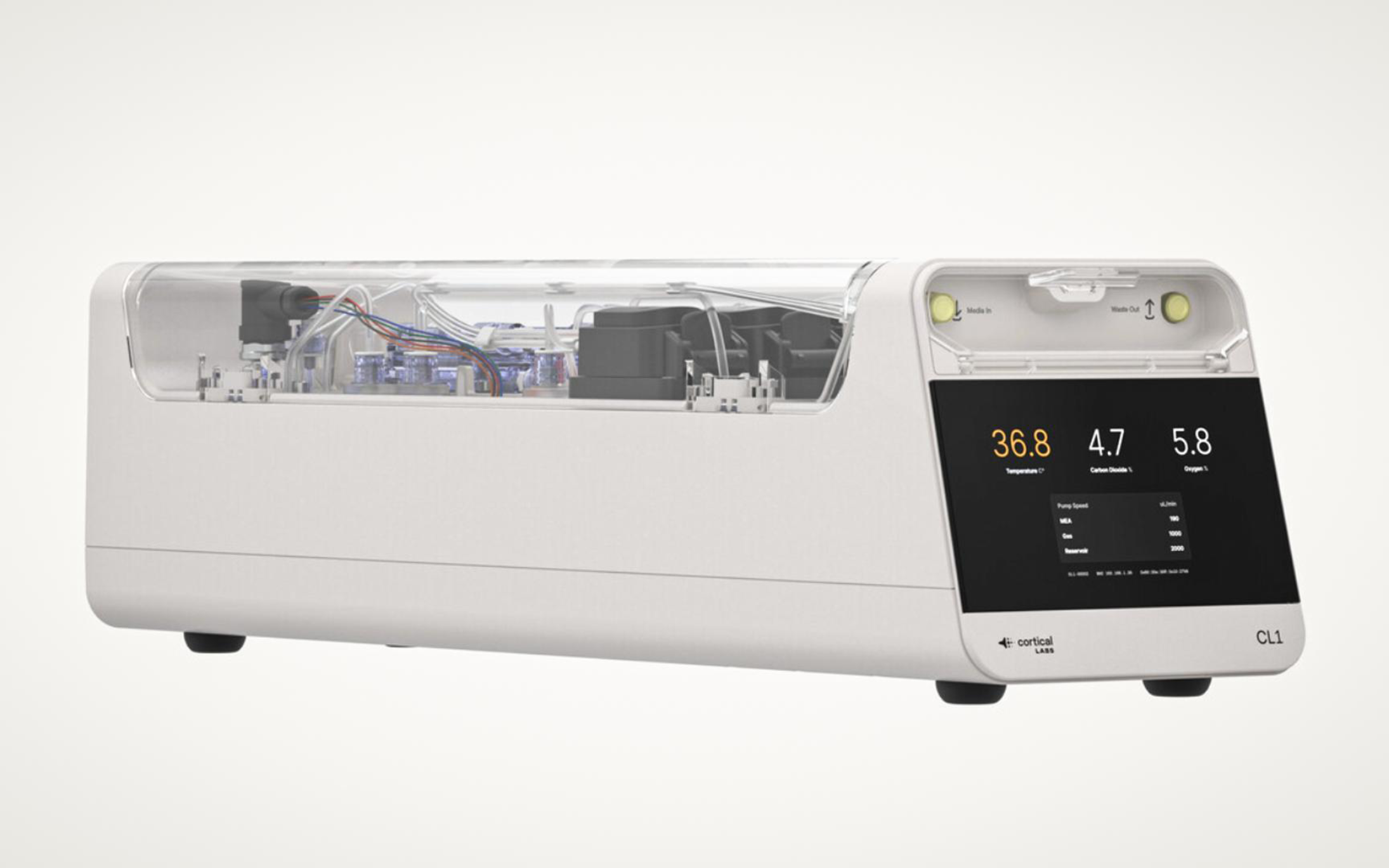
20 CL1 biological computing units sit in a single rack, each one containing at least 800,000 lab-grown human neurons on a silicon chip connected to the hardware through microelectrode arrays.
Jeremy SochaHOST
Every three days, technicians feed the neurons a nutrient cocktail of sugar, micronutrients, and pH buffers, while a dedicated gas mixer continuously pumps in the right blend of carbon dioxide, oxygen, and nitrogen.

Pete SmissenHOST
Now, although that sounds like some kind of crazy science fiction, this idea didn't come out of nowhere.
Pete SmissenHOST
The company behind the technology is Cortical Labs, and it's based in Melbourne.
Pete SmissenHOST
Back in 2022, Cortical Labs and other researchers carried out an experiment called DishBrain.
Pete SmissenHOST
They connected groups of neurons to a simulated version of Pong, a simple video game where you use a paddle to hit a ball.
Pete SmissenHOST
Electrical signals gave the neurons information about what was happening in the game.
Pete SmissenHOST
And researchers found that the neurons began changing their activity in response to the game.
Pete SmissenHOST
In other words, they appeared to adapt.
Pete SmissenHOST
Today, Cortical Labs has taken the idea much further.

speaker_0HOST
Right.
speaker_0HOST
We leave the medical labs in San Diego and head across the world to Melbourne, Australia, to a startup called Cortical Labs.
speaker_0HOST
They've taken the stem cells of their own founder and used them to construct active biological computers, which they call CL1s.
speaker_1HOST
And if you look at them, they don't look biological at all.
speaker_0HOST
The neurons are talking back to the computer.
speaker_1HOST
They are completely integrated into the circuit.
speaker_1HOST
And Cortical Labs is not treating this as a quirky academic experiment.
speaker_1HOST
Their vision is aggressively corporate.

David VivancosGUEST
I think more in biology.
David VivancosGUEST
In fact, this Kebedon-Kahal book that you have, the preface is done by the CEO of Cortical Labs, a good friend, Honwood Sun, that is building these brains on a chip, where you have real brains that compute.
David VivancosGUEST
And and you and all your team, these things can start to have these new capabilities of ranks that start to evolve even in smaller setups.
David VivancosGUEST
You don't need to have like a big data center to have an AGI.

Brodie RobertsonHOST
Uh, which was the company? Company with brain computers.
Brodie RobertsonHOST
No, Cortical Labs, Cortical Labs, that's the one.
Brodie RobertsonHOST
Talked about these guys, I don't think it was last week, might have been the week before? Wait, did I talk about this on the podcast? Or did I just talk about it on stream? I don't remember.
Brodie RobertsonHOST
Either way, there are companies like this who are building computers out of neurons, so there probably will come a point where you could do something kinda like a NerveGear.

Tom O'MahonyHOST
These data centers are eating a load of electricity.
Tom O'MahonyHOST
Cortical Labs, they call themselves.
Tom O'MahonyHOST
And they decided, you know what we'll do? We'll join up with a crowd over in Asia, in Singapore, because the Australians will probably go, fucking what?
Gerry McBrideHOST
Honestly, like, you know, we say over in Singapore, but for Australia, that's like us saying, oh, we joined up with a crowd in Scotland.
Tom O'MahonyHOST
And instead of a chip...
Tom O'MahonyHOST
They're finding a bit of brain because brain is top end good gear when you want to get it, you know.
Tom O'MahonyHOST
And you see, in fairness to him, right, they said there's, you know, like the chief executive of Cortical Labs, which is a chap by the name of Catchy, Chong Hong Wang.
Tom O'MahonyHOST
He said, look, lads, biological data centers are just better suited for applications where data sets may be limited.

Alysson MuotriGUEST
Yeah.
Marco WermanHOST
So Cortical Labs is the Australian startup behind this technology being tested in Singapore.
Marco WermanHOST
The company's chief scientific officer, Brett Kagan, told Euronews earlier this year that this technology is, quote, incredibly energy efficient.
Marco WermanHOST
We humans don't require huge amounts of data.

Sophie ValentineHOST
Absolutely fine.
Sophie ValentineHOST
What about using humans as data processing units? So the National University of Singapore's Center for Life Sciences, in partnership with, there's an Australian kind of biotech startup called Cortical Labs, you'll see where I'm going with this, and a data center operator, those three entities have come together and they have built a data center that processes data using living human brain cells.
Sophie ValentineHOST
It gets ickier.
Sophie ValentineHOST
So every three days, laboratory technicians feed the brain cells a cocktail of sugar, micronutrients and pH buffers.
Sophie ValentineHOST
And it gets worse.
Sophie ValentineHOST
And one of the ways it gets worse is that the technology is better, better than the current equivalent.
Sophie ValentineHOST
So this is a quote from Cortical Labs CEO Chonghong Wang.
Sophie ValentineHOST
There is not enough data in the real world to train humanoid robots to do everything that we need the robots to do using traditional servers.

Sophie ValentineHOST
What about using humans as data processing units? So the National University of Singapore's Center for Life Sciences in partnership, um, with...
Sophie ValentineHOST
There's an Australian kind of biotech startup called Cortical Labs, you'll see where I'm going with this, um, and a data center operator.
Sophie ValentineHOST
Those three entities have come together, and they have built a data center that processes data using living human brain cells.
Sophie ValentineHOST
Um, it gets ickier.
Sophie ValentineHOST
I'm, I'm, I'm with you.
Sophie ValentineHOST
And it, it does, it gets worse, and one of the ways it gets worse is that the technology is better, um, better than the current equivalent.
Sophie ValentineHOST
So this is a quote from Cortical Labs CEO, um, Chong Hong Wang.
Sophie ValentineHOST
Sorry, Wang.

Alysson R. MuotriGUEST
Yeah.
Marco WermanHOST
So Cortical Labs is the Australian startup behind this technology being tested in Singapore.
Marco WermanHOST
The company's chief scientific officer, Brett Kagan, told Euronews earlier this year that this technology is, quote, incredibly energy efficient.
Marco WermanHOST
We humans don't require huge amounts of data.
6 more episodes mention Cortical Labs.
Create an account to see the whole feed, search across every transcript, and follow the entities you care about.