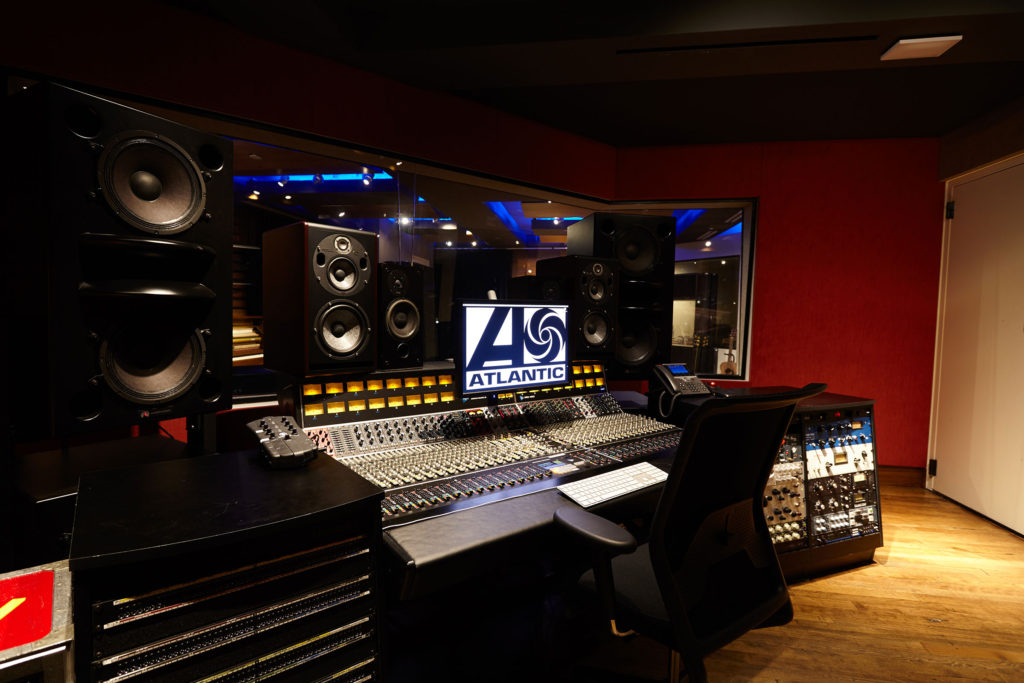
Atlantic Studios

Atlantic Studios

Search complete. 9 mentions across 7 episodes found for "Atlantic Studios".

Oct 27, 2026

Lou GrammGUEST
13:28
That was exciting.
Lou GrammGUEST
13:29
And we recorded the album at Atlantic Records Studio in Columbus Circle.
Lou GrammGUEST
13:35
And as we were coming into the studio, you know who was walking out of the studio? Aretha Franklin.
Lou GrammGUEST
13:41
She had just finished her album.
speaker_0HOST
1:21
In 1960, Ben E.
speaker_0HOST
1:23
King recorded his iconic solo classics Spanish Harlem and Stand By Me at Atlantic Studios in New York City.
speaker_0HOST
1:31
After completing Spanish Harlem, he used the leftover studio time to share the unfinished layout of Stand By Me with producers Jerry Lieber and Mike Stoller, leading them to quickly call the musicians back in so that they could cut Stand By Me.
speaker_0HOST
1:50
In 1975, in an historic media breakthrough, Bruce Springsteen appeared on the front covers of both Time magazine and Newsweek magazine in the exact same week.
Lisa SahulkaHOST
0:09
This was recorded on his album Blues and Roots, going back to 1959.
Lisa SahulkaHOST
0:13
It was recorded at Atlantic Studios, and it features Pepper Adams there on the baritone saxophone.
Lisa SahulkaHOST
0:21
And then Jasmine O'Horn gave us the vocal version of this.
Lisa SahulkaHOST
0:25
She recorded this at the Grammy Awards

Unknown podcast

From Haiti to Jazz: How Refugee Rhythms Sparked New Orleans Sound

Oct 12 · 1 Mention

speaker_1UNKNOWN
7:05
Trumpeter Don Cherry, bassist Charlie Hayden, and drummer Billy Higgins, all seasoned players who had worked in hard bop circles but were open to experimentation.
speaker_1UNKNOWN
7:18
The group was recorded on May 22nd at Atlantic Studios in New York, a venue that had seen everything from jazz legends to pop hits.
speaker_1UNKNOWN
7:28
Now, keep in mind, this wasn't just an artistic choice.
speaker_1UNKNOWN
7:32
It was also a statement about race and economics.

Unknown podcast

The Tutwiler Moment: How One Train Stop Launched Jazz's First Standard

Oct 11 · 2 Mentions

speaker_3UNKNOWN
5:01
So after we talked about Handy and the way a single platform can launch a genre, the next knot in jazz's timeline is a studio session that feels like a small war.
speaker_3UNKNOWN
5:12
The Black Saint and the Sinner Lady was recorded on January 20, 1963, at Atlantic Studios in New York, right when Big Band Swing was giving way to post-bop experimentation.
speaker_3UNKNOWN
5:26
It was Mingus not just playing, but trying to write a ballet for an 11-person band that could stand on its own as a statement of what jazz could become.
speaker_3UNKNOWN
5:37
Mingus had already been pushing the envelope with Mingus Aum and Pythocanthropus, but the Black Saint project was different because it was a single continuous composition that blended hard bop riffs with avant-garde free-form passages.

5 MINS LATER

speaker_2UNKNOWN
11:00
use digital distribution to bypass gatekeepers.
speaker_3UNKNOWN
11:03
The recording technology itself was a key player in shaping the album's sound and its reception.
speaker_3UNKNOWN
11:09
Atlantic Studios used an early 24-track tape machine that allowed Mingus to layer horns, strings, and percussion without compromising clarity.
speaker_3UNKNOWN
11:20
This was revolutionary for a big band context where earlier recordings had been limited to six or eight tracks.

Unknown podcast

Congo Square: The Birthplace of Jazz's Global Conversation

Oct 11 · 1 Mention

speaker_1UNKNOWN
4:49
He swapped the original chord changes for a simple E major vamp and let that stretch become his own.
speaker_1UNKNOWN
4:57
The record was recorded at Atlantic Studios in New York, with McCoy Tyner, Elvin Jones, and Steve Davis supporting him.
speaker_1UNKNOWN
5:06
Within weeks, it blew up on the charts and made a name for Coltrane that was almost as famous as his earlier hard bop work.
speaker_1UNKNOWN
5:14
Critics were split right away.
Theresa DeanGUEST
8:31
He said, "I don't need an office," and it, it, that's the way that place was.
Theresa DeanGUEST
8:37
It wasn't like, "Oh, I need a corner office, I need to look at Broadway, I need this, I need that." It just wasn't.
Theresa DeanGUEST
8:43
It was such a great place.
Adam DornHOST
8:44
Can I, can I ask you, Teresa, when my father hired Michael, was it, like, as an assistant, or was it as... 'Cause I know he mentored him, you know, and he brought him along in the recording and producing, but what was his actual job? I've never really known this.

41 MINS LATER

Joe MardinHOST
50:22
Right.
Theresa DeanGUEST
50:22
You know, they got the sales part, they got the promotion part.
Theresa DeanGUEST
50:26
They didn't get 1841 Broadway.
Theresa DeanGUEST
50:29
They couldn't envision even what the place looked like.

We value your privacy

We use cookies to understand how you use our platform and to improve your experience. Click “Accept All” to consent, or “Decline non-essential” to opt out of non-essential cookies. Read our Privacy Policy.